Monday, October 11, 2010

Wilderness Trekking School: Student Perspective

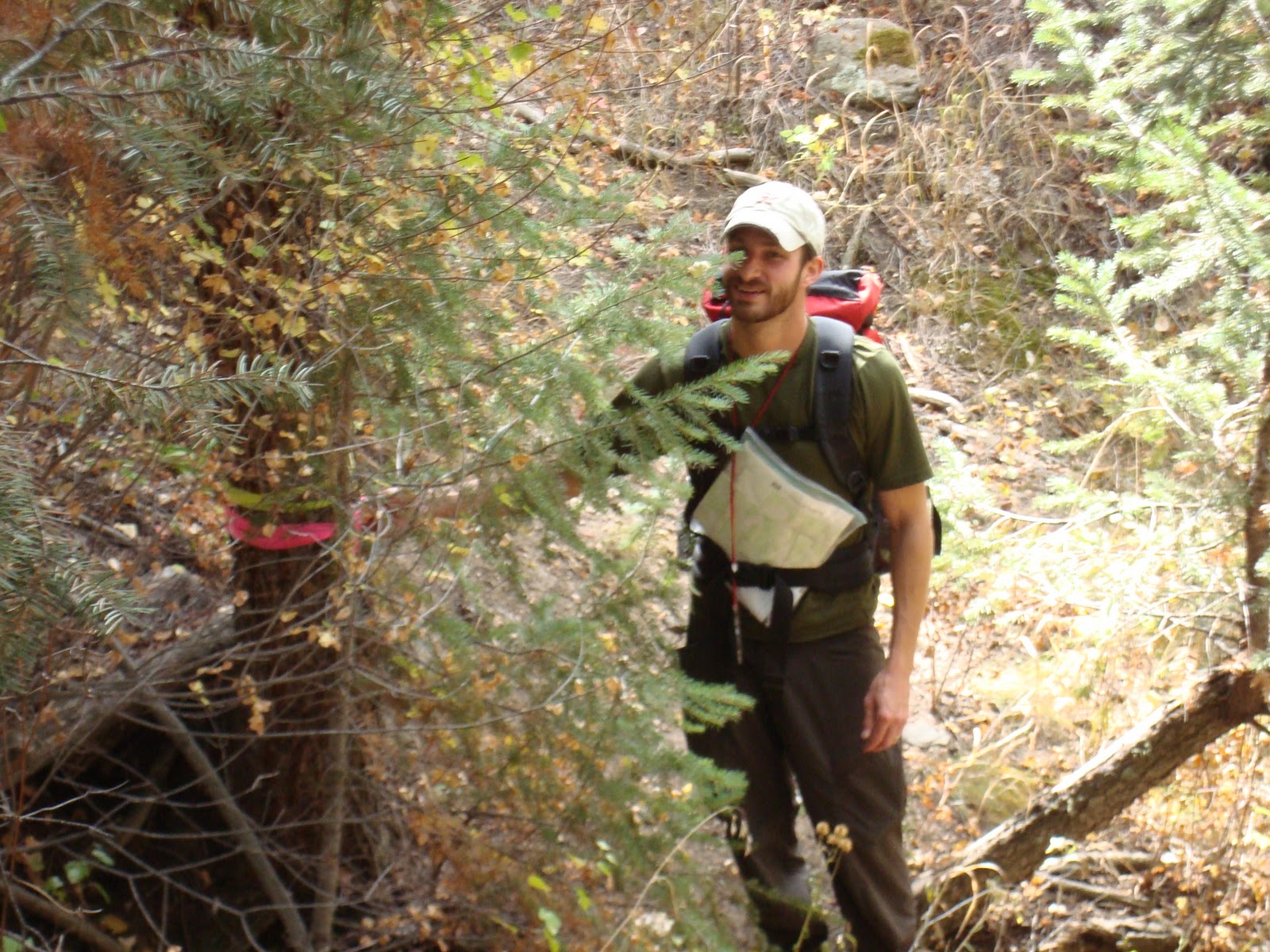
Last Sunday marked the second field lecture for Wilderness Trekking School's Fall schedule:  Map and Compass Day at Genesee Park.  Students met for a group lecture for lessons on measuring distance, map reading and compass use.  Following the lecture, students split up into smaller groups to find marked points using their Evergreen Quadrangle topographic map off-trail.  For more information on WTS, visit their site: http://cmcschools.org/ 

Here's Marco's account of his day in the woods....

CMC – Denver –Wilderness Trekking School (Group 20)


Field Day 2 – 10/3/2010

I had slept through my alarm and my wife woke me up and asked “Marco, do you still plan on going to your compass day?” I fly out of bed and have about 10 minutes to get ready to make it to the Park N’ Ride on time. I skipped breakfast and did a last minute check for all the things I will need for compass day. I ended being quite un-prepared, but I will explain later.

I had climbed Pawnee Peak and Mt. Toll on Saturday. I had a great chance to also get Shoshoni Peak but decided against it so I could be somewhat fresh for the compass day. We ended up hiking much more than I originally thought.

Arrive at the Park N’Ride to smiles from the team members and instructors I am coming to become familiar with more and more. I am not generally a morning person at all, but with so many people smiling at you saying “Good morning”, how can you stay in a grumpy mood!

Our instructor Wayne gets the car pooling figured out and I ride with another instructor Tim, and a team member Mark. I was secretly hoping to be on Mark’s group for this exercise because he is our “ringer”, regarding orienteering and really knows his stuff.

We arrive at Ralston elementary and I realize that everybody on the team has their plastic bag, their index card, a pencil, their compass, their area write-ups, ALL THEIR POINTS PLOTTED. I start feeling a bit anxious. I had my compass, my map, a plastic bag and that was it. I think my rush to get out of my house and be on time is what caused me to forget all these important tools for compass day. Either way, I should have had all my points plotted and I did not, I had planned to attend the Study Hall last Tuesday and get expert help but my day job was not going to let that happen.

Sunday's large group practicing compass use in the field.
Word to the wise, plot your points before hand. We walk from the parking lot to the lecture area (about a half a mile away). From the parking lot we were told to count our “paces” so we can come up with an approximate distance between the parking lot and the lecture site. We are told to take a step with the right foot, then left foot and then that counts as 1 pace. However, I liked Tim’s idea about counting every step and then dividing by two. One thing that was hard for me was to keep what 100 I was on. By the end I had counted 870 paces or so, but thought it could have been 970 because I missed a count on a 100. I think a very large loquacious dog was placed at the end of this walk to muck up my 100 count, hard to count spaces with pretty much any noise.

After the short lecture, I felt better about using the compass and understanding the concepts associated with it. I thought the poor man’s altimeter was so cool (especially when I was shown how to use it correctly). The two lecturers, Joe Griffith and Jack Reed, were very knowledgeable and fun to listen to.


At the end of the lecture we go back to our respective groups. The whole group walks off trail heading towards our first control point close to Bald Mountain. We learn about the “Leapfrogging” technique as we find this control point. We site somebody ahead of us and make sure they stay on the bearing. It is much like “Dead Reckoning” in thick woods or jungle. Except you are using people. Later on we would use objects in the wilderness to site our bearings (dead trees, tree stumps, etc). We make it to the control point. We learn firsthand the importance of making the leapfrog distance shorter between people, we move more efficiently and accurately with a shorter distance between us. Rich takes time to explain the “Box” method to me. If you run into an obstacle and your bearing goes right through it (say a Lake, cliff, ravine), how do you navigate this obstacle? That is where pacing comes in. Go 90 degrees from your current bearing (if heading east +90 to your current bearing), count your paces, clear the obstacle, change back to original bearing, pace back with the obstacle behind you.

Taking a bearing in the field while practicing the "leapfrogging" technique.
Our group (20) was then split into two groups to go out and find points. Unfortunately, I did not get put on Mark’s team! However, this was probably a good thing because Alli, Karen, Rachel, and I really worked well together to find our way to and from different points. It is great to have such knowledgeable instructors, but I was amazed to see how much I learned from my team. At first I was a bit shy to ask for help with points and I am just a bit dense with True and Mag. By the end of the day, I felt completely comfortable asking any question I wanted. Even if I had already asked it, this type of skill requires repetition, and I was not going to let my feelings of inadequacy impair what I want to learn.

Marco with the first point in Section 1
Our group was able to successfully find three points, without ever having stepped foot on a trail! We had problems finding the last point but Wayne seemed convinced something had happened to the flag.

Having fun with points by the end of the day.
We meet up with our other group around 5pm (long day) and walk back to Ralston Elementary. From there we all meet at Jose O’Shea’s for a cold one and some food. It was fun to recap events that happened throughout the day with the team in a social setting. I had a great time. Can't wait till the next field day-Survival Day at White Ranch!

Wednesday, October 6, 2010

Upper Blue Lake Unhike

Member Marilyn Raff joined by several other CMC friends recalls a brilliant hike filled with native plants, high-mountain wildlife and impressive mountain peaks. Raff is the author of 4 books, her most recent is a poetry collection called: In the Palm of the Land, all available through Amazon.

On August 11, a sizzling hot day in Denver, I, along with five club members, Lori Giesecke, Joan Schwarz, Gesa Robeson, Sally Boyson, and Dawn Mitchell, headed up to cooler terrain, several miles past Breckenridge. We met early at the Stegosaurus parking lot, off I-70, to carpool to the mountains and catch gentians and other wildflowers in bloom. Dawn created these unhikes several years back for hikers wishing less vigorous treks, with minimal walking. But still, we all wished to see lush flowers and impressive scenery.

As one of two drivers, in a rather old 1999 Toyota, I followed Dawn up to 11,100 feet, as she weaved up several rocky dirt roads. My heart melted as I viewed fireweed, in blazing reddish purple, along the roadside; it brought back fond memories of when I gardened day and night on my small plot of land.


Several miles out of town, Dawn found wide-open flat space for parking, as well as good rocks for leaning on with the puffy cushions she brought along. She hauled lawn chairs up here, too, for those of us who wanted near-total comfort. As our bodies begged for food and a chilled drink, some people started eating their sack lunches, while others roamed hungrily for wildflowers—a peachy time for all! I wandered along and soon chatted with a man from New Mexico, a former Coloradan, who called the area we stood on, “Upper Blue Lake.”

Mountain peaks, lakes, trickling waterfalls and hordes of verdant trees and plants surrounded us, in spite of the destruction caused by the Mountain Pine Beetle.

On our wanderings, we saw dozens of high mountain plants, as we called to each other to name these eye-catching gems. We viewed monkshood, darling blue chiming bells, as well as wild roses. Various gentians welcomed us, such as Gentiana algida, G. cruciata, G.parryi, and Gentianella amarella var. acuta. Silvery pussytoes clung to rocks, while I smiled when bunches of campanulas stood at my feet. In my home garden I always loved to grow various forms of silenes, and among the rocks, at 11,000 feet, I encountered what I think was Silene alba. Naturally many sedums and king’s crown caught my eye; anemones, too, looked breathtaking under the warm sun.

However, aside from the beautiful hillsides and native plants in their natural habitats, all of us joyfully cheered when we saw wildlife! In particular, a family of seven mountain goats and a yellow-bellied marmot, also known as a ground squirrel, came across our paths. The mountain goats, three nannies and four kids, slowly walked the pebbled land, ignorant of us and other hikers who carefully observed them at a safe distance. Although, once, one hiker slowly approached the goats and a nanny, momentarily, stomped and scratched her hoof on the ground, as a warning, she’s out to protect her kids, so stay back! After a short stop at Georgetown for ice cream, we soon arrived at the parking lot, said our fond good-byes, and looked forward to more plant (and animal) excursions, along with a good dose of friendly visiting, next year!

Monday, October 4, 2010

The ’67 Colorado McKinley Team Leader to Speak at the Boulder Group Dinner

Howard Snyder, author of The Hall of the Mountain King

An important figure in Colorado mountaineering history, Howard Snyder, will speak this year at the annual Boulder Group dinner November 6th.  The former CMC member and trip leader led the 1967 Colorado McKinley Expedition (as Denali was called then). They were forced by the U.S. National Park Service to combine with a group from Seattle for the climb, with fatal consequences. The disastrous expedition, one of the most controversial in North American mountaineering history, was chronicled in the 2007 book Forever on the Mountain by James Tabor, and in Howard’s own 1973 book, The Hall of the Mountain King.
James Tabor's book exposes the controversy that delayed the rescue of the 1967 Wilcox Denali Expedition and cost seven men their lives. Tabor reconstructs the stranded mountaineers’ last days from meager evidence of a camp found near the summit.

Paul Schlichter, another member of the ’67 Colorado McKinley team, also will be in attendance as commentator and honored guest.  Although Howard Snyder has given many presentations on the ’67 McKinley climb in the years since then, this will be the first time both Howard and Schlichter have returned to Boulder, where the expedition began, since 1967.  It’s also the first time the two of them have ever discussed the expedition together in public.  Howard, Paul and a third member of the Colorado team, Jerry Lewis, all reached the summit successfully and survived, as did Joe Wilcox, leader of the Seattle team which the Coloradans were forced to join.  But seven out of nine members of the Wilcox team died on McKinley when they were stranded in high camp by a ferocious storm – making this the most costly mountaineering expedition in North American history in terms of loss of human life. Of the twelve men who ascended McKinley, only five came down alive – including the three Coloradans, fortunately. Howard also will touch on his experiences as a CMC trip leader and the Boulder climbing scene in the 1960’s.
"Paul on summit with flare.  We spent 1½ hours on top in nearly ideal weather.  Temperature on top was 6 degrees F., the second warmest ever recorded up to that time on the summit of McKinley.  Paul had carried two double-ended (day/night) flares all the way to the summit."
The CMC Boulder Group’s annual dinner is a great opportunity to meet and socialize with friends who share a love of the mountains – and to be inspired by powerful guest speakers. The dinner is open to members from any CMC group and also to non-members.


Tickets for the dinner are $11 per person in advance when purchased online, and $15 at the door. Everyone is asked to bring a dish serving at least five.

Howard with eldest daughter Mira, and then 7-month old granddaughter Aria at the trailhead at the North Rim of the Grand Canyon, September of 2009.  The picture was taken by Howard's son-in-law Saska. 
"We were re-enacting a hike of 28 years earlier wherein I had crossed the Canyon rim-to-rim with my wife, our eldest daughter (then 15 months), and my wife’s 62 year-old mother."

Friday, October 1, 2010

Congressman Jared Polis (D-CO) introduced H.R. 6280 – The Eagle and Summit County Wilderness Preservation Act

Thank Rep. Polis for his NEW WILDERNESS BILL!
Last night, Hidden Gems advocates watched from the gallery above the chamber of the House of Representatives in Washington D.C. as Congressman Jared Polis walked down the aisle and delivered the Eagle and Summit County Wilderness Preservation Act to the house clerk! His draft legislation became a bill: H.R. 6280.

Click to read the bill.

It was thrilling - a moment we will not forget for a long time. I wish you could have been there to see it with us. Years of fieldwork, organizing, letter writing, negotiations, and countless e-mails, phone calls, endorsements and letters of support all culminated in a simple act. It was a landmark moment in the effort to achieve new wilderness in central and western Colorado.
Thank you for all you have done to get us to this point. We wouldn't be here if it were not for your work. And neither would the beautiful places below that we will share with generations to come.


As we thanked Rep. Polis for his leadership in protecting the special lands in Eagle and Summit Counties, he mentioned how important it had been to him to receive so many expressions of support for new wilderness as he worked on the bill. He also mentioned that if people were excited to hear about the bill's introduction that he would like to hear that as well.

Let's share with him how excited we are!

Rep. Polis is a true wilderness champion. Please take a moment to let him know how excited you are about new wilderness in Summit and Eagle Counties! Click here to send a letter to Congressman Polis.
And if you are a mountain biker, click here to include in your letter to him why you support wilderness as a biker.

The CMC Conservation Department and the Hidden Gems Team thank you for your continued support.

If you support this bill and the CMC Conservation Department's efforts, please take a moment to share the below message with your friends.


**********************

SAMPLE EMAIL TO SEND TO A FRIEND

**********************

Dear Friend,

I just wrote a letter in support to Congressman Polis thanking him for introducing a new wilderness bill in Eagle and Summit Counties. Can you take a moment to write him as well. If we can show a groundswell of support it will encourage senators Udall and Bennet to introduce their own bill and give Mr. Polis the support he needs to push hard for passage of his bill this year. It takes less than a minute. Thanks so much.

Here's the link where you can send the letter- it just takes a few clicks!
http://org2.democracyinaction.org/o/5857/p/dia/action/public/?action_KEY=4302

If you are a mountain biker click here or go to this link http://org2.democracyinaction.org/o/5857/p/dia/action/public/?action_KEY=4303

For more information on the bill go to http://polis.house.gov/Wilderness/

Now is the time. Your support is needed. Please write a letter today!

Thanks!

Thursday, July 22, 2010

Trekking in Nepal, September 25, 2010

Join Pemba Sherpa, a native of the Khumbu region of the Nepal Himalayas on this spectacular trek along the foothills of some of the world’s highest peaks. Pemba has been guiding visitors to his homeland since 1986 and will do so again in 2010, taking us into the heart of the world’s majestic Himalayan Mountains and into the rarely visited Lumding Valley. Very few Westerns have ever ventured into this completely unspoiled valley!
We will be surrounded by striking scenery as we trek through virgin terrain while marveling at views of Everest and its neighbors. We will also spend time with Pemba’s family in the small Sherpa village of Sengma and will relax for a couple of days in Nepal’s colorful capital city of Kathmandu. Sign up!

Ama Dablam